 EN

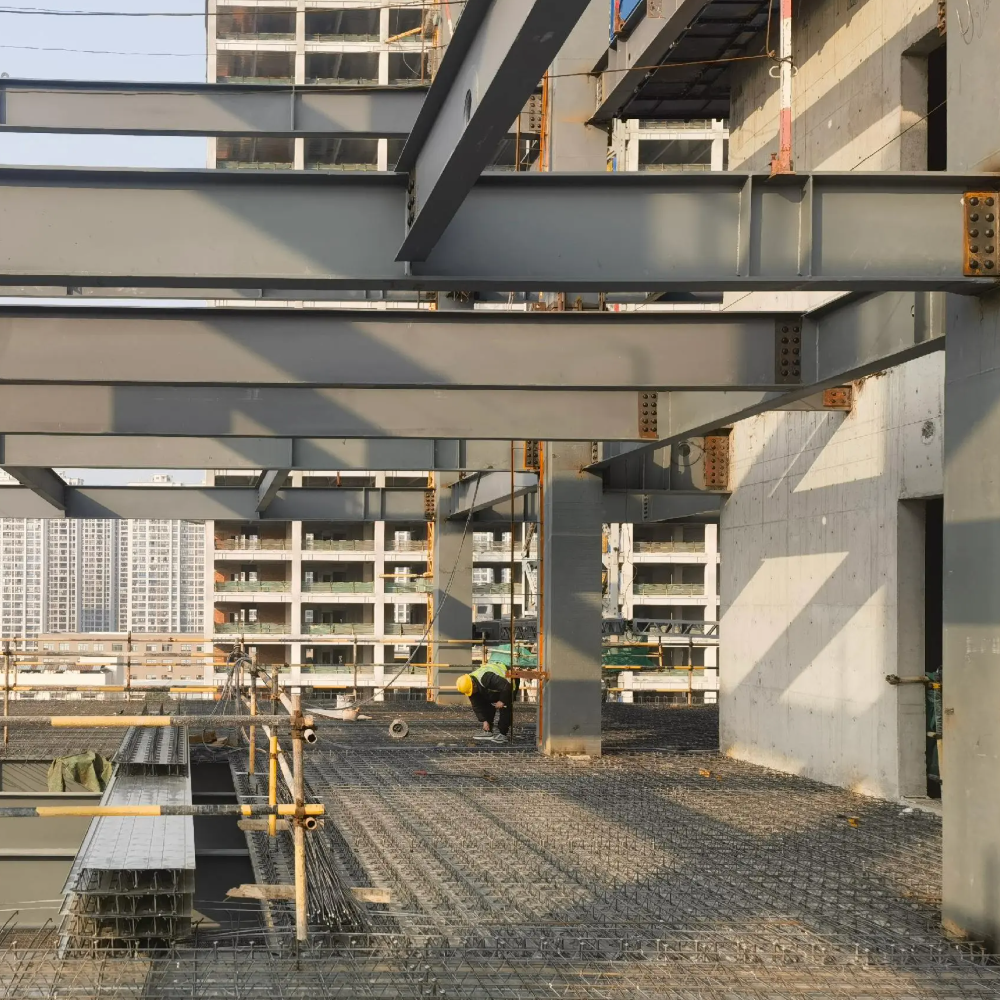
Fundamental Mechanics: How Section Geometry Dictates Load Path and Stability
Among the types of purlins used in cold-formed steel roof systems, Z- and C-sections dominate because their thin open geometry balances weight, bending stiffness, and connection simplicity. The cross-section shape—not steel grade alone—sets the primary load path and stability limit.
Z- vs C-Section Purlins: Bending Capacity, Deflection Control, and Neutral Axis Position
Z- and C-sections differ sharply in symmetry and neutral-axis behavior. A C-section has one axis of symmetry; its shear center lies outside the web, so a vertical load applied through the top flange introduces torsion unless roof sheeting or bridging restrains rotation. In fully braced gravity bending, the neutral axis initially coincides with the centroidal horizontal axis. After web local buckling, AISI S100 effective-width rules shift the neutral axis toward the compression flange, which can reduce the effective section modulus by up to 30% for slender webs.
A Z-section is point-symmetric, and its principal axes rotate relative to the web—typically 8–14° depending on lip and flange proportions. Vertical load therefore produces bending about both principal axes, potentially causing lateral deflection if the top flange is unbraced. However, when roof decking restrains the loaded flange, the section develops its full vertical bending capacity. Lapped Z-purlins over interior supports improve continuity: they increase negative-moment capacity and can reduce midspan deflection by 20–35% compared with an equivalent single-span C-section.
Torsional Rigidity and Resistance to Lateral-Torsional Buckling Under Asymmetric Loading
Both C- and Z-purlins are open thin-walled sections, so their St. Venant torsional rigidity is low and warping torsion contributes significantly to resistance. Under wind uplift or unbalanced snow, the compression flange may be on the unbraced bottom side—making lateral-torsional buckling (LTB) the governing limit state. This asymmetry is more critical for C-sections because the offset shear center amplifies torsional demand when loads act through the top flange.
Z-sections perform better in lapped continuous systems: overlapping webs and flanges create localized torsional stiffness near supports, enhancing restraint where negative moments occur. Still, both shapes rely on sag rods, bridging, or standing-seam clips between supports to control LTB. AISI S100 applies unbraced-length reduction factors; when the unbraced length equals the full span, moment capacity under uplift drops to 60–75% of the fully braced value. Section geometry alone does not ensure stability—bracing layout and load direction determine actual torsional and LTB performance.
Performance Comparison of Common Purlin Types
The choice among common types of purlins in cold-formed steel roof systems depends on span configuration, lap requirements, and roof diaphragm participation. C, Z, U, and stiffened-web profiles each serve a distinct performance range.
| Purlin type | Bending efficiency | Torsional rigidity | Typical span range | Best-fit application |
|---|---|---|---|---|
| C-section | Moderate; strong-axis bending efficient for simple spans | Lower; shear center offset from web | 3–6 m | Simple spans, bearing-critical zones, cladding supports |
| Z-section | High; lapped nesting increases continuity and reduces deflection | Moderate to high when lapped | 6–12 m | Continuous spans, low-slope roofs, diaphragm action |
| U-section | Lower; limited depth and web stability | Low | ≤ 4 m | Light-duty purlins, canopies, ancillary framing |
| Stiffened-web / sigma profile | Higher local buckling resistance from web stiffeners | Moderate | 4–9 m | Long-span applications with optimized steel weight |
Z-sections generally outperform C-sections in continuous lapped systems because the nested geometry transfers shear across the lap and enables continuous-span flexural behavior. By contrast, C-sections are easier to detail at simple supports and remain common where web crippling governs design. U-sections often serve as light-gauge edge members rather than primary roof purlins. Stiffened-web profiles can reduce steel mass while improving local buckling resistance, but their lap and connection details require more fabrication care. AISI design provisions recognize lap length and fastener pattern as explicit strength inputs for Z-purlin systems. Therefore, section selection should follow structural demand, span continuity, and bearing conditions—not material cost alone.
Connection Behavior and System-Level Integration with Roof Decking
Among common types of purlins, Z-sections and C-sections respond differently when attached to steel roof decking. Their connection details govern how gravity, wind uplift, and diaphragm forces move from the deck into the supporting framing.
Overlap Efficiency, Composite Action, and Shear Transfer in Z-Purlin Systems
Z-purlins gain much of their structural advantage from lapped connections over interior supports. In multi-span systems, overlapping two Z-sections reverses orientation at each support without requiring a separate splice. This lap creates continuous flexural behavior and shifts negative moment toward the support. A longer overlap increases joint rotational stiffness, reduces midspan deflection, and improves load redistribution. When roof decking is fastened to every rib with screws or welds, the deck acts as a shear diaphragm—bracing the purlin’s top flange against lateral movement and lowering lateral-torsional buckling risk. Shear transfer follows two paths: through lapped web bolts and through deck-to-purlin fasteners. The combined path resists wind uplift and gravity loading more evenly. Proper lap detailing can therefore reduce required purlin depth and weight for a given span. Because different types of purlins behave differently, Z-sections often provide the most efficient continuous system when positive deck attachment is present.
C-Purlin Limitations in Continuous Spans and Bearing-Critical Zones
C-purlins present different constraints when integrated with roof decking. Because C-sections cannot lap over supports without distorting the web profile, continuous span behavior typically relies on bolted sleeves or end-bearing brackets. These connections create local stiffness discontinuities and concentrate rotation at the support. Unlike lapped Z-purlins, the top flange is not automatically reversed, so negative moment resistance depends more on hardware and web stiffening. At bearing-critical zones, web crippling often controls capacity. The narrow vertical web must transfer reaction into the support without local buckling or bearing failure. Short bearing lengths, oversized holes, or missing web stiffeners can sharply reduce ultimate load. Roof decking provides diaphragm restraint, but it does not correct the web crippling weakness at the support. For this reason, C-purlins are frequently specified as simple spans or with closer support spacing, which may increase material use under high suction or heavy snow.
Validated Performance Insights from Testing and Industry Standards
CSIRO, SCI, and AISI Test Data on Web Crippling, Bearing Capacity, and Serviceability Limits
Independent laboratory programs from CSIRO, SCI, and AISI provide repeatable benchmarks for the main types of purlins. In web crippling tests, Z-sections often show higher ultimate bearing capacity than C-sections of equal mass because their inclined webs direct reaction forces more efficiently into the tension field. AISI S100 provisions reflect these differences through separate bearing coefficients for end and interior conditions. SCI data on continuous Z-purlin systems confirm that lap length and fastener position alter serviceability limits more than material yield strength alone. Under repeated loading, deflection recovery remains stable when bearing stiffeners or anti-roll clips are installed at supports. For C-sections in bearing-critical zones, test results show earlier web buckling under concentrated reactions unless nested or reinforced. These findings guide minimum bearing lengths and clip spacing in roof specifications, reducing premature local failure. Across all test series, measured serviceability limits depend strongly on section profile, support width, and load eccentricity. Together, CSIRO, SCI, and AISI test data help designers select among types of purlins based on measured web crippling and serviceability performance—not nominal section depth alone.
FAQ
What are the main types of purlins used in construction?
The main types of purlins used in construction include C-section, Z-section, U-section, and stiffened-web or sigma profiles. Each purlin type is designed for specific structural demands and applications.
What are the key differences between Z-section and C-section purlins?
Z-section purlins are point-symmetric and are better suited for continuous spans, offering high bending efficiency and torsional rigidity when lapped. In contrast, C-section purlins are generally used in simple spans and bearing-critical zones but have lower torsional rigidity.
Why are Z-section purlins preferred for continuous span systems?
Z-section purlins are ideal for continuous span systems because of their ability to lap over supports, creating a stiffer and more efficient structural connection. This enhances bending strength and reduces deflection, making them suitable for long spans and low-slope roofs.
What is lateral-torsional buckling (LTB), and why is it important?
Lateral-torsional buckling (LTB) occurs when a beam or purlin deflects and twists due to instability. It is an important consideration for thin-walled sections, as it can limit their load-carrying capacity, particularly under wind uplift or unbalanced snow loads.
How does roof decking contribute to purlin system stability?
Roof decking acts as a shear diaphragm, bracing purlin flanges against lateral movement, distributing loads, and reducing lateral-torsional buckling risks, especially in Z-purlin systems with secure deck attachments.
What are the common limitations of C-section purlins?
C-section purlins face limitations such as web crippling and difficulty in achieving continuous-span behavior without additional components, making them more suited to simple spans or closely spaced supports.
What factors influence the selection of purlin types?
Purlin type selection primarily depends on structural demands, span requirements, roof diaphragm action, load conditions (like wind or snow), and specific project needs.
Table of Contents
- Fundamental Mechanics: How Section Geometry Dictates Load Path and Stability
- Performance Comparison of Common Purlin Types
- Connection Behavior and System-Level Integration with Roof Decking
- Validated Performance Insights from Testing and Industry Standards
-
FAQ
- What are the main types of purlins used in construction?
- What are the key differences between Z-section and C-section purlins?
- Why are Z-section purlins preferred for continuous span systems?
- What is lateral-torsional buckling (LTB), and why is it important?
- How does roof decking contribute to purlin system stability?
- What are the common limitations of C-section purlins?
- What factors influence the selection of purlin types?