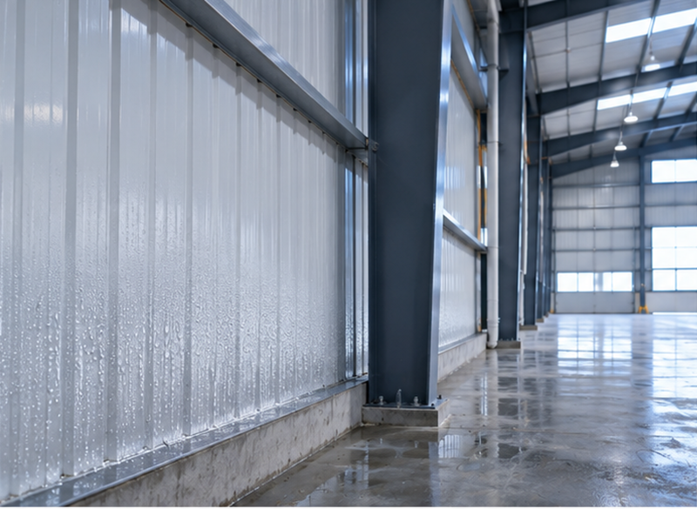
After a steel-structure warehouse enters service, droplets may appear on the inner face of wall panels or water stains may develop below purlins. Site personnel often first suspect a roof leak and request an additional bead of exterior sealant. Yet the location where water becomes visible is not necessarily where it entered. Rainwater can migrate along lap joints and structural surfaces, while indoor water vapor can condense directly on cold metal. Treating these two mechanisms as one often leads to a familiar result: the condition seems to improve briefly after resealing, only for damp marks to reappear with the next seasonal change.
From the technical perspective of Shenyang Zhongwei Heavy Industry Steel Structure Engineering Co., Ltd. (Zhongwei Heavy Industry), the first priority in this type of after-sales investigation is not to recommend a particular material, but to formulate fault hypotheses that can be tested against evidence. Diagnosis should begin with three questions: Do the damp marks coincide with rainfall? Are they concentrated at low-temperature locations, such as column edges, fasteners, or door-opening corners? Have the building's temperature, humidity, ventilation, or production conditions changed? The answers determine what should be measured next.
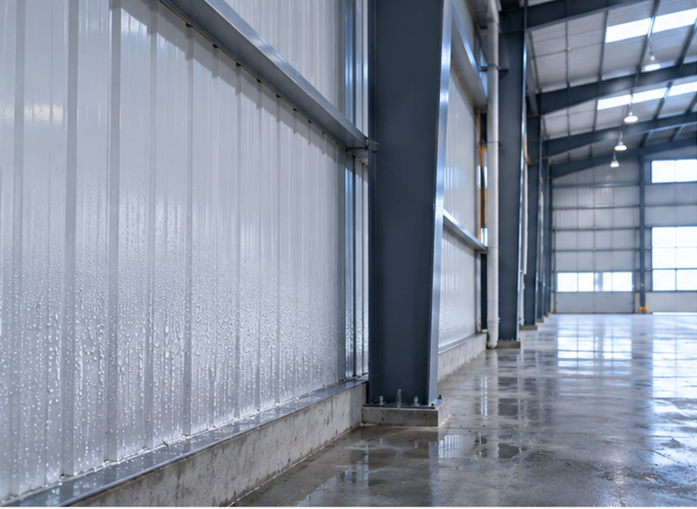
The same damp wall can tell very different stories depending on when the moisture appears. A localized stain that develops and expands after wind-driven rain suggests an external rainwater entry path should be investigated. Fine droplets spread across a broad interior surface on a rain-free morning and gradually disappearing by afternoon are more characteristic of surface condensation. Moisture confined to a cold-storage door, loading bay, or particular steel column should prompt examination of local airflow and thermal bridges. These observations are clues, however; none is sufficient on its own to declare that rainwater leakage has been ruled out.
Site records should cover at least a continuous day-night cycle and, wherever possible, be correlated with rainfall, wind direction, door-opening duration, and equipment operating logs. Photographs should identify the location, time taken, and wet or dry condition of the same area. If repeat measurements are required, the measurement points should remain fixed; taking a reading at a column base today and at a roof ridge tomorrow produces data that cannot be meaningfully compared. For insulated storage facilities and buildings with frequently operated large doors, indoor operating records may explain short-lived condensation more effectively than outdoor weather data alone.
Water vapor in air does not turn into liquid simply because it encounters metal. Surface condensation becomes possible only when the local surface temperature approaches or falls below the dew-point temperature of the adjacent air. Consider an illustrative condition, not a measured warehouse case: indoor air at 25°C and 70% relative humidity has a dew point of approximately 19.1°C when calculated using a common approximation. A metal connector with an actual surface temperature of only 16°C would therefore be at clear risk of surface condensation, while an adjacent, continuously insulated panel surface above the dew point might remain dry.
These figures are not field measurements from any warehouse and do not replace a long-term hygrothermal assessment. Dew point changes with air temperature and humidity; metal surface temperature is also affected by nighttime radiative cooling, wind, solar radiation, indoor air movement, and the configuration of structural connections. A single measurement showing that a wall is 'above the dew point' does not exclude condensation that may have occurred several hours earlier. Conversely, a surface below the dew point demonstrates that condensation conditions exist, but does not automatically rule out simultaneous rainwater ingress.
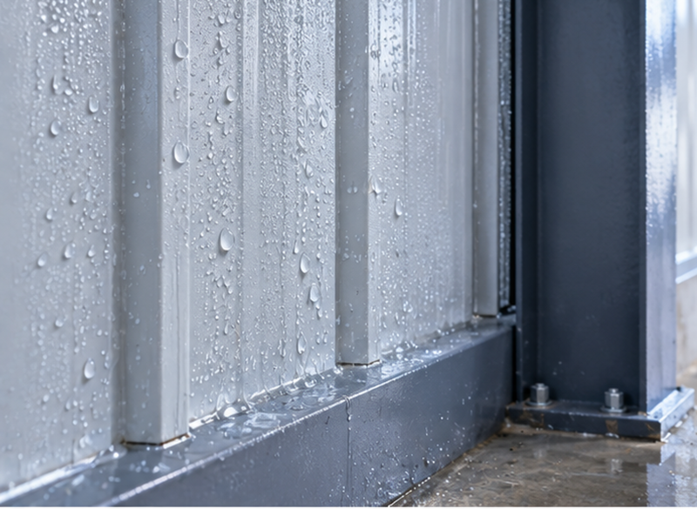
A common site observation is that large areas of sandwich panel remain dry while steel columns, girts, and connections to purlins become damp first. This is not, by itself, evidence of poor steel quality. Steel conducts heat readily, and continuous metal paths can bypass the insulation layer, lowering the temperature of the local interior surface. The nominal panel thickness, the thermal conductivity of its core, and the actual minimum surface temperature at a particular connection are three different performance indicators. Comparing only the insulation thickness of two panel products may overlook the connection details that determine where condensation forms.
ISO 10211:2017 sets out requirements for two- and three-dimensional numerical models used to calculate heat flow through thermal bridges and minimum surface temperatures. At repeatedly affected column edges, profiled-sheet laps, or through-fasteners, condensation risk should not be inferred solely from an assembly's overall thermal transmittance. The actual connection geometry, contact conditions, and boundary temperatures should be taken into account. ISO 6946:2017 provides calculation methods for thermal resistance and thermal transmittance for certain building components, but its scope is limited with respect to complex, continuous metallic thermal bridges; it cannot replace detailed analysis of a connection.
In some warehouses, the exterior panel has no obvious opening and the interior surface may show few droplets. Yet once a section of trim is removed, the insulation or the back of the liner is already damp. Air leakage must then be considered. Driven by pressure differences between indoors and outdoors, buoyancy arising from temperature differences, or mechanical supply and exhaust systems, humid air can pass through discontinuously sealed laps, service penetrations, door frames, and roof-to-wall junctions into colder concealed cavities, where its moisture condenses. Vapor diffusion and moisture transport by moving air are different mechanisms and require different remedial strategies.
ISO 13788:2012 provides simplified calculations for surface humidity and interstitial condensation, but explicitly does not cover important phenomena such as air movement through gaps into an assembly. Where time-dependent moisture absorption, drying, and migration need to be considered, engineering assessments may refer to the moisture-control analysis framework in ANSI/ASHRAE Standard 160-2021 and its amendments. This does not mean every isolated damp spot requires a complex numerical model. The essential point is to recognize the conditions under which simplified methods cease to be reliable.
A metal panel that resists rain on its exterior face does not automatically provide the entire envelope with an appropriate vapor-control strategy. Sandwich-panel cores, membranes, sealing tapes, vapor-control layers, and connection materials may have different water-vapor transmission properties. A theoretically effective vapor barrier can lose much of its practical performance if it is repeatedly penetrated by screws and joints without maintaining continuity. Conversely, adding a high-vapor-resistance membrane without assessing the assembly's drying direction may trap moisture that is already present inside the layers.
ISO 12572:2016 and its 2024 amendment specify cup-method procedures for determining the water-vapor transmission properties of materials. They provide a basis for material testing, not an off-the-shelf solution to warehouse condensation. Material selection must still account for the relationship between the building's warm and cold sides, climate, indoor moisture loads, and continuity at panel joints. Particularly in refrigerated storage, food processing, and high-humidity industrial facilities, there is no universally applicable global rule for whether the interior or exterior side requires greater vapor resistance.
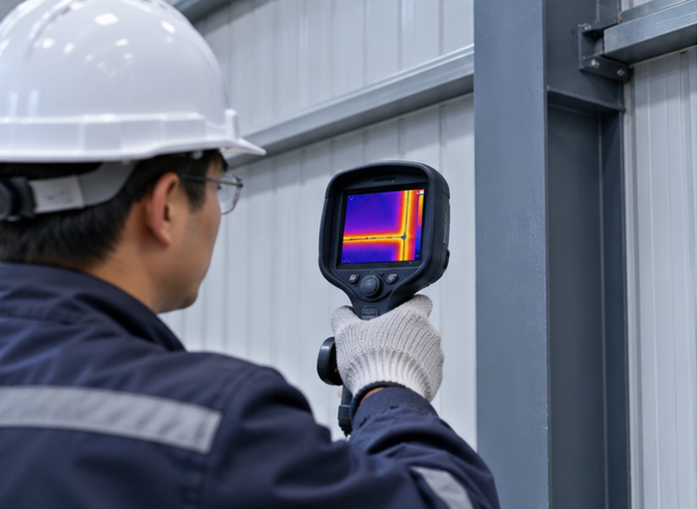
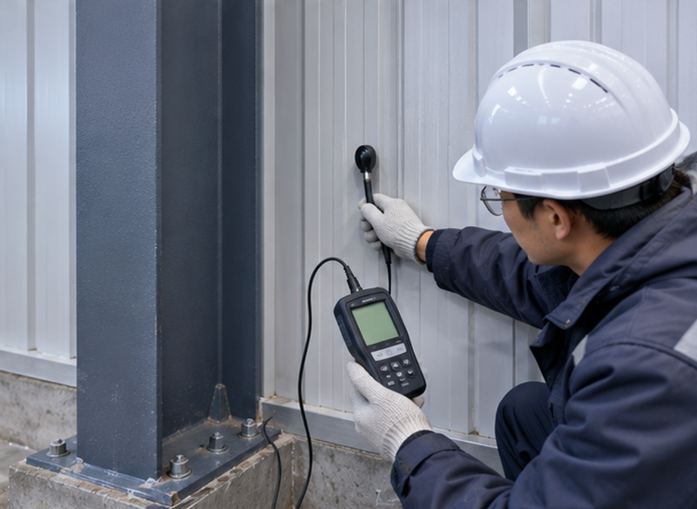
At locations that can be accessed safely, begin by recording indoor and outdoor air temperatures, relative humidity, and surface temperatures at multiple points. Calculate the corresponding dew points and plot the findings on a plan of the building. Infrared thermography can help identify temperature anomalies, but metallic surfaces are highly reflective. Images can be misleading if emissivity, measurement angle, or reflected apparent temperature has not been appropriately accounted for. A cool-colored region in a thermal image is not proof of moisture and certainly does not, by itself, establish a defect in a weld or structural member.
If rainwater leakage is suspected, use controlled, zone-by-zone observations informed by exterior laps, flashings, traces of gutter overflow, and wind and rain conditions. Laboratory test methods developed for windows, doors, or curtain-wall assemblies should not be presented as a universal acceptance standard for an entire metal wall-panel system. Before any necessary localized opening-up inspection, define protection, reinstatement, and safety measures. Where insulation cores are suspected to be wet, assess both their potential to dry and whether replacement is necessary; simply closing the surface should not be treated as completion of the service case.
When the evidence points to external water ingress alone, the priority is to correct drainage paths, construction laps, and damaged seals—not to block every possible outlet. If a local thermal bridge is the main issue, evaluate thermal breaks, connection liners, and insulation continuity, then verify whether the minimum interior surface temperature has increased after remedial work. If air leakage is responsible, a continuous airtight layer and proper treatment of penetrations are generally more targeted than merely increasing insulation thickness. If the building's moisture load substantially exceeds the design assumptions, dehumidification, ventilation arrangements, and process-moisture extraction must also be evaluated.
Each remedial action should have defined verification conditions. A wall being dry on the day of repair is not enough to establish that the problem has been resolved. Recheck under indoor humidity, outdoor temperature, and operating conditions comparable to those associated with the original failure, comparing temperatures, surface-temperature-to-dew-point differences, and visible damp marks at the same locations before and after the work. Because weather conditions cannot be recreated exactly, monitoring over a period of time may be needed. The statements 'the symptom has disappeared' and 'the root cause has been demonstrated to be eliminated' should be kept distinct.
Consider a hypothetical ambient-temperature warehouse, not an actual project. During its first winter after handover, vertical damp marks appear around three steel columns while the rest of the wall remains largely dry. A full panel replacement is proposed. Suppose an investigation finds that the marks are concentrated where the columns meet the wall girts, appear in the morning without worsening during rain, and that temperature logs show the connection surfaces periodically dropping below the indoor dew point. The hypothesis that 'the panels have failed throughout' would then have little evidentiary support. The next step should be to check thermal bridging at the connections, seal continuity, and ventilation conditions rather than immediately ordering replacement panels.
This scenario illustrates diagnostic reasoning only; it is neither a Zhongwei Heavy Industry project case nor an actual after-sales service record. The value of a technical article is not in inventing claims about how much money a repair saved, but in showing how engineers use contrary evidence to narrow the range of possible causes and avoid unnecessary dismantling and replacement. For an owner, an investigation report should clearly distinguish verified findings, unresolved questions, and the conditions needed for the next verification step, rather than offering only before-and-after photographs.
Persistent moisture affects more than the appearance of the wall. Repeated condensation may dampen goods packaging, alter the performance of insulation materials, and increase localized corrosion and cleaning or maintenance requirements. Some warehouses operate without problems initially, only to develop condensation after a change in stored goods, the addition of steam-generating equipment, or more frequent loading operations. This does not necessarily mean the original building design was inappropriate, nor does it prove that the building has no weak details requiring correction. Both the building and the conditions under which it is used must be considered together.
For international B2B buyers, after-sales technical capability can be assessed through a sequence of problem definition, evidence collection, mechanism-based diagnosis, and targeted verification—not merely by response times and repair promises. By publishing specialized articles of this kind on its independent website, Shenyang Zhongwei Heavy Industry Steel Structure Engineering Co., Ltd. aims to explain technical issues in steel-structure warehouses clearly. Effective condensation control depends on managing moisture sources and local temperature conditions, rather than attributing every damp mark to a leak. Each actual project still requires an independent assessment based on local climate, applicable regulations, contractual requirements, and available site data.
The following standards support the methods of technical analysis discussed here. Their inclusion does not constitute a claim that the company has tested, certified, or demonstrated compliance for any particular project. The applicable editions must be confirmed against local regulations, contracts, and the requirements of the relevant authorities.
ISO 13788:2012 — Hygrothermal performance — Internal surface temperature and interstitial condensation — Calculation methods
ISO 10211:2017 — Thermal bridges — Heat flows and surface temperatures — Detailed calculations
ISO 6946:2017 — Building components — Thermal resistance and thermal transmittance — Calculation methods
ISO 12572:2016 + Amd 1:2024 — Hygrothermal performance — Determination of water vapour transmission properties — Cup method
ANSI/ASHRAE Standard 160-2021 + Addendum a (2024) — Criteria for Moisture-Control Design Analysis in Buildings
Leave your project requirements and get exclusive solutions for free!
E-mail: [email protected]
 EN